Uber's engineering culture is built around massive scale, real-time tracking, and thousands of microservices. If you are interviewing for a backend role, your system design skills will be pushed to their limits.
The Uber Loop Structure
Expect a rigorous loop tailored towards distributed systems. Recent candidate reports show an increased focus on concurrency, multi-threading, and handling race conditions during the coding rounds.
- Phone Screen: 1 hour. Standard DSA (often medium/hard).
- Onsite (Virtual): 5 rounds.
- 2x Coding / Algorithms
- 1x System Design (Architecture)
- 1x System Design (Deep Dive / API Design)
- 1x Hiring Manager (Behavioral)
Mastering the Uber System Design
You need to understand how to design systems that handle millions of concurrent connections and geospatial queries.
- Geospatial Data: Learn how Quadtrees and Geohashes work. You will likely be asked to design a system that finds the nearest drivers.
- Consistency vs Availability: How do you handle network partitions when matching a rider to a driver? (Hint: You prioritize availability).
- Event Sourcing: Understand Kafka and event-driven architectures.
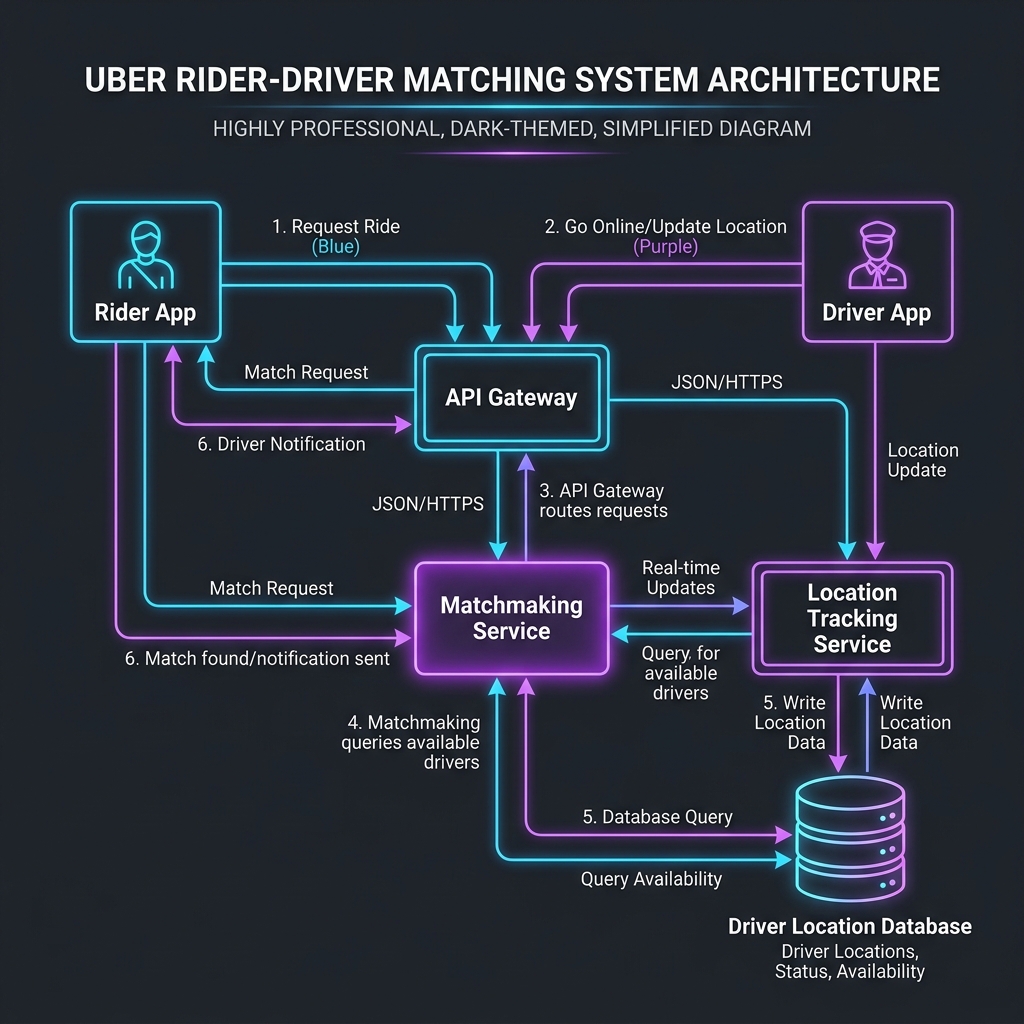
Uber Rider-Driver Matching Architecture
A classic Uber system design question asks you to design the rider-driver matching service. Key components include:
Free Prep Resources
Related Resources:
- System Design Playbook — Critical for Uber's system design rounds
- AI/ML Interview Guide — ML for pricing and matching at Uber
- Backend Interview Questions — Distributed systems focus
- Airbnb Interview Prep — Similar marketplace engineering
- Stripe Interview Prep — Payment systems overlap