If you've been grinding "Reverse a Linked List", put it away. Stripe doesn't care. Stripe cares if you can read documentation, make HTTP requests, refactor messy code, and design API surfaces.
Here is the breakdown of the Stripe software engineering onsite loop and how to beat it.
The Stripe Loop Structure
Stripe's onsite typically consists of 4-5 rounds, and they are unique compared to the rest of FAANG. Candidates universally report Stripe's loop as one of the most practical and close to actual day-to-day engineering work.
- Coding / Pair Programming: A practical coding exercise (often working with JSON or building a small CLI tool).
- The Integration Round: (Notorious). Making API calls to a mock server, handling pagination, rate limits, and parsing responses.
- The Bug Bash Round: You are given a large, open-source repository (or a complex mock repo) with a failing test. Find and fix the bug.
- System Design: Usually API-design heavy.
- Behavioral / Manager Chat: Focusing heavily on Stripe's operating principles (e.g., "Users First", "Move with Urgency and Focus").
How to Ace the Integration Round
This is the round that catches most candidates off guard. You will be asked to integrate with a mock API.
- The Setup: Have your development environment ready. Know how to make HTTP GET/POST requests in your preferred language without having to Google the syntax.
- The Gotchas: The mock API will return paginated results, it will randomly throw 429 Rate Limit errors, and it might return malformed JSON. You need to write robust code that handles retries with exponential backoff.
- Action: Practice by writing a script that fetches data from the GitHub API, paginates through 100 pages of repositories, handles rate limits, and aggregates the data into a specific format.
How to Ace the Bug Bash Round
You will be dropped into a codebase you've never seen before. The code will be large.
- The Strategy: Do not try to read all the code. Run the failing test immediately. Look at the stack trace. Use grep/search to find where the error originates.
- Communication: Talk out loud. "I see the test is failing on line 42 because `user.id` is null. Let me trace where `user` is instantiated."
- Action: Practice navigating large open-source repos on GitHub. Find an open issue, fork it, and try to locate the bug within 15 minutes.
Stripe System Design: API First
While Google asks you to design a global CDN, Stripe is more likely to ask you to design an API for a payment gateway, a ledger system, or a webhook delivery system.
Focus on:
- Idempotency: Crucial for payments. How do you ensure a user isn't charged twice if they click the "Pay" button twice? (Idempotency keys).
- ACID Transactions: You must understand database transactions, row-level locking, and concurrency control.
- Webhook Design: How do you design a reliable system to push events to users? (Retries, dead letter queues, signature verification).
Stripe Payment Processing Architecture
A classic Stripe system design question asks you to design a payment processing system or ledger. This is the most defining question in a Stripe interview because it directly maps to what the company builds. Key components include:
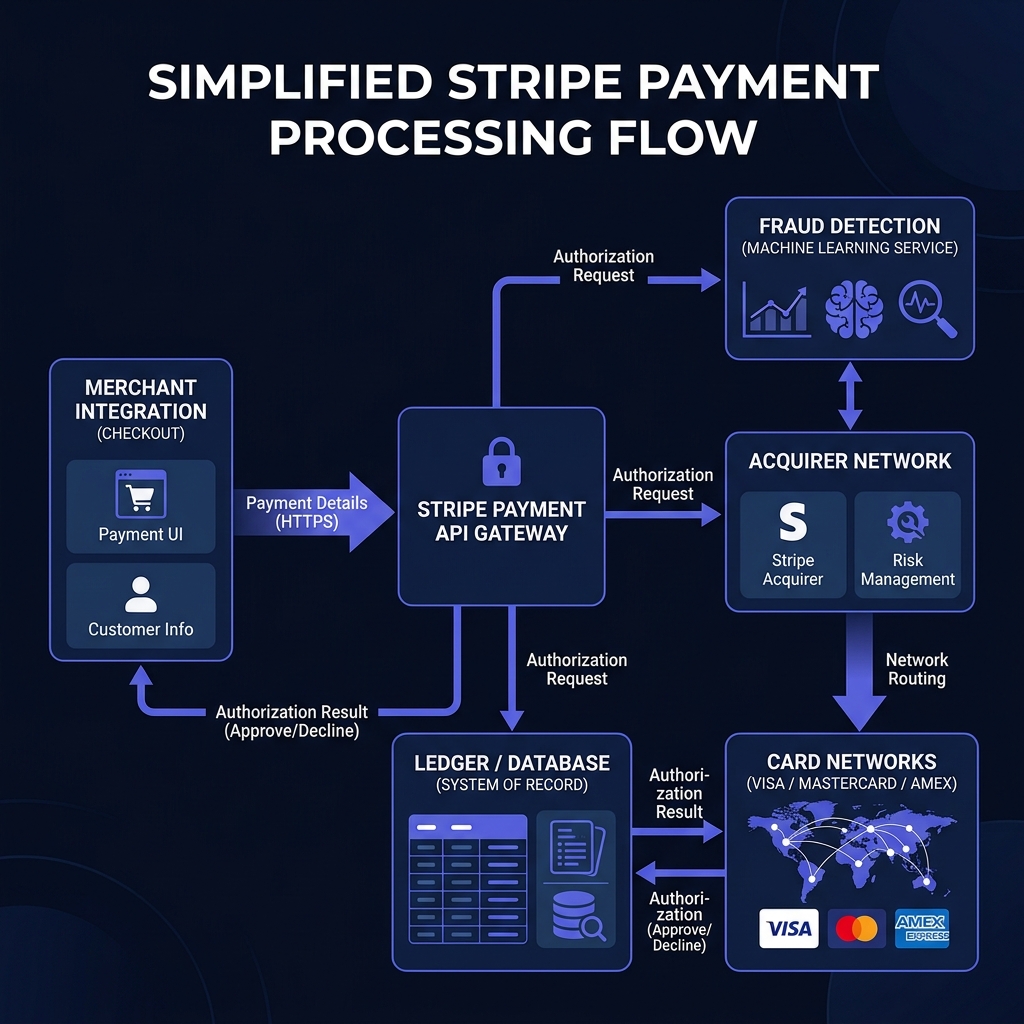
- Payment Intent API: The entry point. Client creates a PaymentIntent with an amount and currency. Discuss why this is a two-step process (create → confirm) rather than a single charge endpoint — it supports 3D Secure, Apple Pay, and other asynchronous payment methods.
- Idempotency Layer: Every mutation must have an idempotency key. If a client retries (network timeout), the server returns the original response instead of processing the payment twice. Discuss how you'd implement this: a hash map with TTL? A database table with unique constraints?
- Ledger System: Double-entry bookkeeping. Every transaction creates two entries: a debit and a credit. The sum of all entries must always be zero. This is how Stripe catches discrepancies and prevents money from being created or destroyed.
- Webhook Delivery: Asynchronous event delivery to merchants. Discuss retry strategy (exponential backoff, max 3 days), signature verification (HMAC), and dead letter queues for permanently failed deliveries.
- Reconciliation Service: Runs periodically to compare internal ledger state with external payment processor state. Any discrepancy triggers an alert. This is critical for financial compliance.
Common Stripe Interview Questions by Round
Stripe Integration Round Questions
- "Write a script that fetches all transactions from this paginated API and calculates the total revenue by currency."
- "The API returns 429 errors randomly. Modify your code to handle rate limiting with exponential backoff."
- "Parse this JSON response and flatten nested objects into a CSV format."
Stripe Bug Bash Round Questions
- "This test is failing:
expected 200 but got 500. The codebase has 15 files. Find and fix the bug." - "The payment webhook is being delivered but the merchant's status never updates. Debug the pipeline."
- "This function returns incorrect results when the input contains Unicode characters. Find and fix it."
Stripe System Design Questions
- "Design a webhook delivery system that guarantees at-least-once delivery with retry and dead letter support."
- "Design a rate limiter for an API gateway that handles 100K requests per second across multiple regions."
- "Design a ledger system for tracking account balances across currencies with real-time reconciliation."
For the general system design framework, see our System Design Playbook. For agentic system design (increasingly asked at Stripe for ML roles), see the Agentic System Design Mock.
Free Prep Resources
Related Resources:
- System Design Playbook — Foundational system design framework
- SDE-2 Interview Prep — Stripe's Bug Bash round expectations
- Backend Interview Questions — API design and payment systems
- Airbnb Interview Prep — Similar engineering culture
- AI/ML Interview Guide — ML for fraud detection at Stripe