Getting an interview at Google is hard. Passing it requires a specific type of preparation. Google's hiring committee is notoriously stringent, relying on a consensus model where even one "No Hire" signal can tank your packet.
If you have three weeks before your onsite, this is exactly how you should spend your time.
The Google Loop Structure
For a standard SWE (L4/L5) role, expect the following:
- Phone Screen: 1 round (45 mins). Pure algorithmic coding. Usually conducted on a shared Google Doc or CoderPad.
- Onsite (Virtual): 4 to 5 rounds.
- 3x Technical/Coding (DSA)
- 1x System Design (For L4+, mandatory for L5+)
- 1x "Googleyness & Leadership" (Behavioral)
- Team Matching: (Recent Trend) For many roles, passing the loop does not guarantee an immediate offer. You will enter a "team matching" phase where you must be selected by a specific manager. This can take weeks or months.
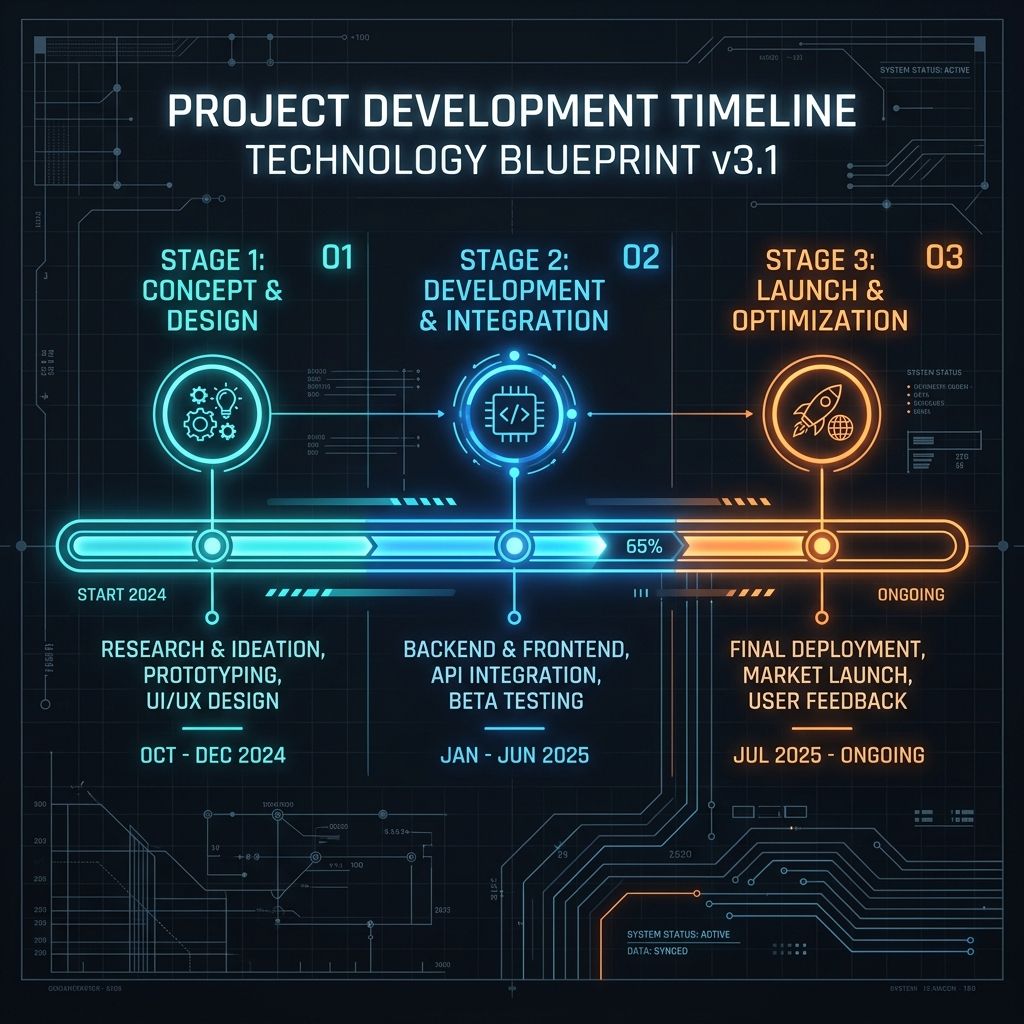
Week 1: DSA Fundamentals & "Googleyness"
The Coding Bar
Google loves Graphs, Trees, and Dynamic Programming. They rarely ask you to implement a basic linked list. They will ask you to find the shortest path in a 2D grid with obstacles (BFS), or evaluate a math expression (Stacks/Trees).
Recent Trend (2023-2024): Interviewers are heavily indexing on clear communication and "thinking out loud". Even if you don't reach the perfect optimized solution immediately, dry-running test cases and incorporating interviewer hints can still earn a "Strong Hire".
Action: Sort LeetCode by "Google" and "Frequency". Do not memorize the answers. Google interviewers are trained to mutate standard questions. If you know how to solve "Number of Islands", they will ask "Number of Islands, but diagonal connections count."
Googleyness
This is their cultural fit round. They are looking for navigating ambiguity, valuing user feedback, and "doing the right thing".
Action: Prepare 4 stories using the STAR-L method (Situation, Task, Action, Result, Learning). Focus on a time you failed, a time you had a conflict, and a time you led a project without formal authority. See our Behavioral Interview guide for the full framework and example answers.
Week 2: Planetary-Scale System Design
At L5 (Senior), this round decides your level. If you ace the coding but bomb system design, you will be downleveled to L4. For the foundational framework, read our System Design Last-Week Playbook.
Google operates at a scale most engineers never see. When they ask you to "Design YouTube", they want to see if you understand global distribution.
- Focus on Data Partitioning: How do you shard the database when one celebrity uploads a video that gets 10M views in an hour?
- Focus on Latency: Mention CDNs, edge computing, and geo-routing.
- Google-Specific Tech: You don't have to mention Spanner or Bigtable, but understanding why they exist (global strong consistency) gives you massive bonus points when discussing database trade-offs.
Google Distributed Search Index Architecture
A classic Google system design question asks you to design a distributed web crawler or search index. This is one of the most revealing questions because it touches every layer of a distributed system. Key components include:
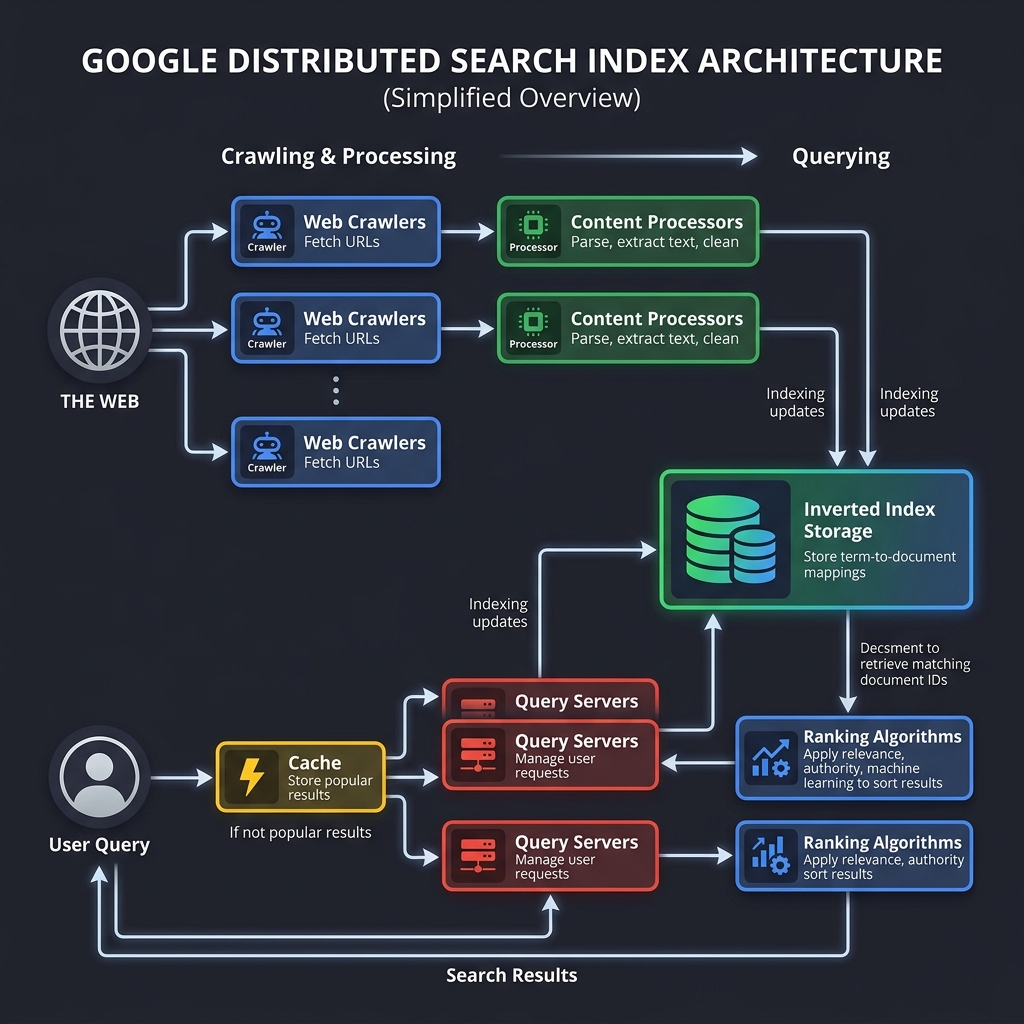
- URL Frontier / Scheduler: Maintains a priority queue of URLs to crawl. You need to discuss politeness policies (don't DDoS a single domain), URL deduplication (Bloom filters or a distributed hash set), and freshness scheduling (how often to re-crawl pages that change frequently).
- Crawlers (Distributed Workers): Stateless workers that fetch HTML. Talk about horizontal scaling, handling timeouts/retries, and robots.txt compliance. A strong candidate mentions that DNS resolution becomes a bottleneck at scale and discusses local DNS caching.
- Content Processing Pipeline: Parses HTML, extracts text, strips boilerplate. This is where you discuss deduplication at the content level (simhash or MinHash for near-duplicate detection) and language detection.
- Inverted Index Builder: The core of search. Maps terms → document IDs. Discuss how Google shards this index (by document ID range or by term range), how they handle updates (batch vs. real-time indexing), and the trade-off between index freshness and build cost.
- Serving Layer: Handles query parsing, retrieves posting lists from the inverted index, scores documents (TF-IDF, BM25, plus PageRank and hundreds of other signals), and returns ranked results. Mention the scatter-gather pattern: a query coordinator fans out to multiple index shards and merges results.
The key trade-off to discuss: freshness vs. cost. Re-crawling the entire web frequently is expensive. Google uses a tiered approach — high-priority pages (news sites) are crawled every few minutes, while static pages might be re-crawled weekly. Interviewers want to hear you reason through this kind of practical constraint.
Week 3: Mock Interviews & Communication
Google evaluates Communication as a distinct axis. Writing perfect code in silence is a "Leaning Hire" at best. Writing good code while actively discussing edge cases, time/space complexity, and alternative approaches is a "Strong Hire".
Action: Do at least 3 mock interviews. Practice typing while talking. State your naive solution within the first 5 minutes.
Google Coding Interview Questions by Level
Google L4 (SWE II) Interview Questions
At L4, Google focuses on algorithmic problem-solving and clean code. Expect:
- "Given a stream of stock prices, find the maximum profit from at most k buy-sell transactions." (Dynamic programming)
- "Design a data structure that supports insert, delete, and getRandom in O(1)." (Hash map + array swap trick)
- "Find the shortest path in a grid with obstacles, where you can remove at most k obstacles." (BFS with state)
What separates L4 from L3: At L4, interviewers expect you to identify the optimal approach within 5-10 minutes and discuss time/space complexity without prompting. L3 candidates get more hints.
Google L5 (Senior) System Design Questions
L5 system design is the level-deciding round. Common questions include:
- "Design YouTube's video processing pipeline" — Emphasize fan-out, CDN distribution, and adaptive bitrate streaming
- "Design Google Maps turn-by-turn navigation" — Discuss graph algorithms (Dijkstra/A*), real-time traffic updates, and client-server communication for live routing
- "Design a real-time collaborative document editor" — Discuss CRDTs vs. OT (Operational Transformation), conflict resolution, and latency optimization
For the complete system design framework, use our System Design Playbook.
Google Googleyness & Leadership Questions
- "Tell me about a time you had to navigate ambiguity without clear direction from leadership."
- "Describe a situation where you had to push back on a decision you disagreed with."
- "Give an example of when you prioritized doing the right thing over the expedient thing."
Prepare these using the STAR-L framework. Google's behavioral bar is lower than Amazon's but still causes rejections — especially at L5+ where they evaluate leadership without formal authority.
Free Prep Resources
Related Resources:
- System Design Playbook — 7-day framework for system design rounds
- Behavioral Interview Guide — STAR-L framework and answer templates
- Backend Interview Questions — 50 questions on databases, APIs, and distributed systems
- Microsoft Interview Prep — Compare Google vs. Microsoft interview loops
- Stripe Interview Prep — Another top-tier engineering interview