Interviewing at Amazon is unlike any other FAANG company. While Google indexes heavily on theoretical algorithmic purity, Amazon indexes almost entirely on data-driven execution and behavioral alignment.
If you don't master the 16 Leadership Principles (LPs), you will fail. Even if you write perfect code.
The Amazon Loop Structure
For a standard SWE (SDE II or Senior SDE) role, expect:
- Online Assessment (OA): 2 LeetCode Mediums + a Work Style Assessment (Behavioral).
- Phone Screen: 1 hour. 20 mins of LP questions, 40 mins of coding.
- Onsite (Virtual): 4 to 5 rounds.
- Every single round has 20-25 minutes of Leadership Principle questions.
- 2x Coding (DSA)
- 1x System Design (Object-Oriented Design for SDE I/II, Distributed Systems for Senior)
- 1x Bar Raiser round (Heavy behavioral + architecture)
Recent Trend (2024): Many candidates report encountering a specialized "GenAI" discussion or systems round, depending on the specific team you are interviewing for.
Cracking the Leadership Principles
You cannot fake your way through the LPs. Interviewers will dive deep into your stories. Recent candidate reports confirm that LPs are used as hard filters — failing the LP questions using the STAR method will result in rejection, even with perfect coding scores.
- Customer Obsession: When did you push back on a feature because it was bad for the user?
- Deliver Results: When did you have an impossibly tight deadline and how did you cut scope to launch?
- Dive Deep: Tell me about a time you investigated an incredibly complex bug. How many layers deep did you go?
Action: Prepare a grid of 6-8 core stories. Map each story to 2-3 LPs. Ensure you have concrete metrics for every result. For the complete STAR-L framework and answer templates, see our Behavioral Interview guide.
Amazon Leadership Principles Interview Questions
Here are the most commonly asked LP questions at Amazon, organized by principle. Prepare a story for each:
- Customer Obsession: "Tell me about a time you went above and beyond for a customer (or end user) — even when it wasn't the most efficient thing to do."
- Ownership: "Describe a time you took on something outside your area of responsibility because it needed to be done."
- Invent and Simplify: "Tell me about a time you found a simpler solution to a complex problem."
- Are Right, A Lot: "Give an example of when you had to make a decision with incomplete data. How did you approach it?"
- Bias for Action: "Tell me about a time you made a decision quickly, knowing you could course-correct later."
- Earn Trust: "Describe a time you had to deliver difficult feedback to a peer or manager."
- Dive Deep: "Tell me about a complex bug or system issue that required you to investigate multiple layers."
- Have Backbone; Disagree and Commit: "Describe a time you disagreed with your team's direction. What did you do?"
Pro tip: Amazon interviewers will always follow up with "What would you do differently?" and "What was the specific metric impact?" Have these ready for every story.
Amazon E-Commerce Order Processing Architecture
A frequent Amazon system design question is designing an order processing pipeline or a shopping cart system. This tests your understanding of distributed transactions and eventual consistency — core Amazon engineering challenges. Key components include:
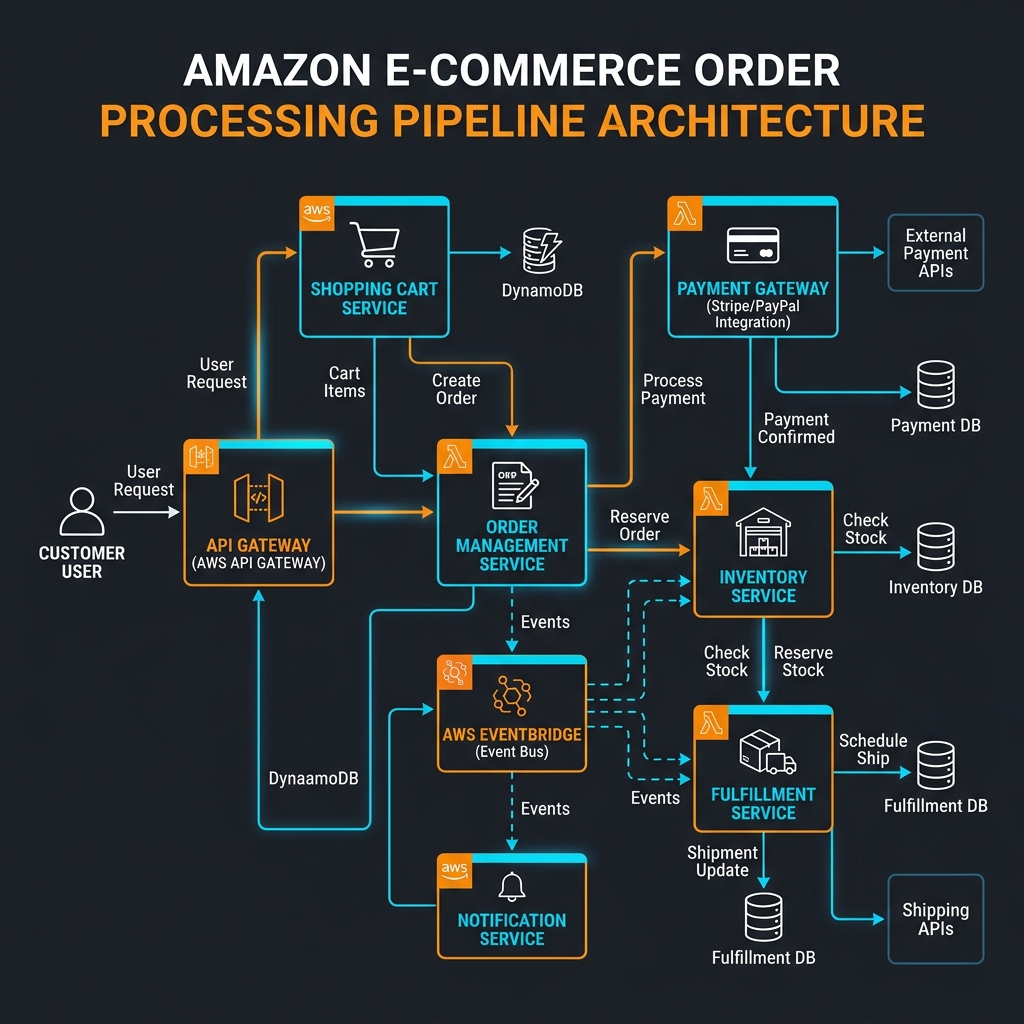
- API Gateway + Load Balancer: Routes requests to the appropriate microservice. Discuss rate limiting, authentication, and how you'd handle a flash sale where traffic spikes 100x.
- Cart Service: Stores the user's cart. Discuss whether to use a session-based approach (server-side) or a client-side approach (JWT tokens with cart data). Trade-off: server-side is more reliable for abandoned cart recovery; client-side scales better.
- Order Service + Payment Service: Must be transactional. Discuss the Saga pattern for distributed transactions — when the payment succeeds but inventory reservation fails, how do you roll back? This is where idempotency keys become critical.
- Inventory Service: Needs strong consistency for stock counts. Discuss pessimistic locking (SELECT FOR UPDATE) vs. optimistic locking (version numbers) and when each is appropriate.
- Notification Service: Asynchronous via SQS/Kafka. Discuss dead letter queues for failed deliveries and the trade-off between at-least-once and exactly-once delivery semantics.
For the full system design framework and time-budgeting strategy, see our System Design Playbook.
Free Prep Resources
Related Resources:
- Behavioral Interview Guide — Essential for Amazon's LP-heavy interview
- System Design Playbook — 7-day framework for system design rounds
- Backend Interview Questions — 50 questions on APIs, databases, and distributed systems
- Google Interview Prep — Compare Amazon vs. Google interview loops
- Microsoft Interview Prep — Another FAANG alternative